
on Swabia
We present here evidence indicating a man from the Balkans, carrying Y-DNA variants associated with subclade E-BY4793, migrated to Swabia about two millennia ago and that one of his Swabian descendants subsequently originated the E-BY165986 subclade. Such evidence is intended to be considered in the context of our broader analysis of the history of Roman recruitment in the Balkans and their dispersal into areas of Britain and Western Europe.
This is a visual summary involving the hypothetical recruitment by the Roman Legions or Auxiliaries of a man of the E-BY4793 subclade of haplogroup E-V13, likely born in the Balkans early in the first millennium, and assigned to military duty in the area historically referred to as Swabia in modern Southwestern Germany. It is then likely a descendant of this recruit was the originator of the E-BY165986 subclade, in or around the 7th century.
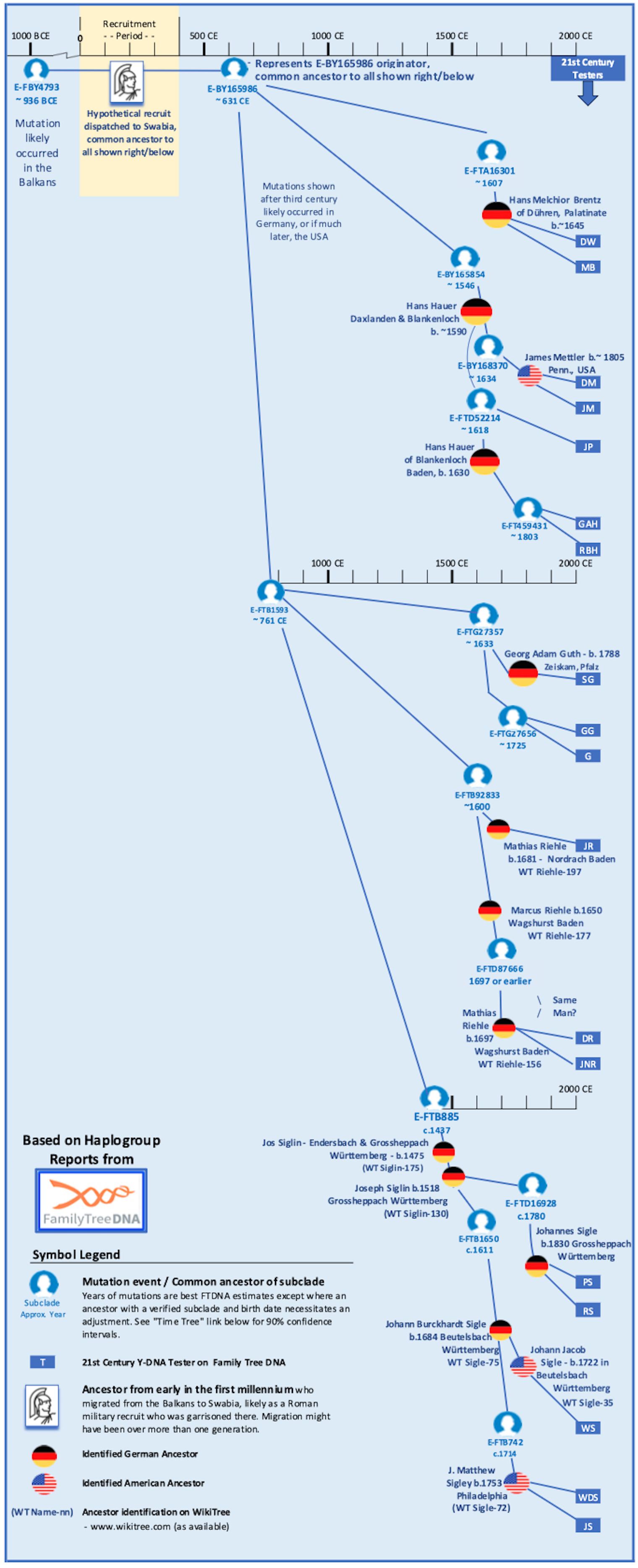
Note that while the man who migrated to Swabia would likely have been in subclade E-BY4793, there is a chance (perhaps about 1 in 10) that the E-BY165986 mutation occurred among that migrant’s recent ancestors, or at his own conception before leaving the Balkans. This 10% is a very rough estimate, considering that the variant could have occurred very early within the probability interval assigned by Family Tree DNA and rather late in the period of Roman recruitment in the Balkans.
Moreover, while all of our testers’ identified ancestors in or near Swabia carried the E-BY165986 variants, this does not preclude the possibility that other lineages, with as yet unidentified mutations, might have branched off from our E-BY4793 lineage after our migrant arrived in the region but before the defining BY165986 mutation occurred. Such a branch would have most of the variants identified with E-BY165986 but would have one or more additional variants not found in E-BY165986 and its subclades. While we have not encountered evidence of this, with perhaps several hundred years between the arrival of our E-BY4793 ancestor in Swabia and the E-BY165986 mutation, such other lineages and subsequent mutations would have to be considered likely. If so, we anticipate ongoing Y-DNA testing will show this to be the case.
Article: Sons of the Legion?